Review: Shrek (2001)
An unusual and delightful fairy tale that the Brothers Grimm could never have imagined.

Fairy tales are stories featuring fantastical and magical elements that typically revolve around princesses, wizards, enchanted objects, talking animals, and other magical beings. They are believed to have originated thousands of years ago, when they were passed down through oral tradition. However, the fairy tales as we know them today—that is, as a literary genre with a well-defined narrative structure—were established in the late seventeenth century by Charles Perrault. The Brothers Grimm, in turn, collected a wide range of traditional stories from different cultures—especially German folklore—and adapted them into literary form, establishing the modern standard for these tales and becoming the most influential figures in the fairy tale genre.
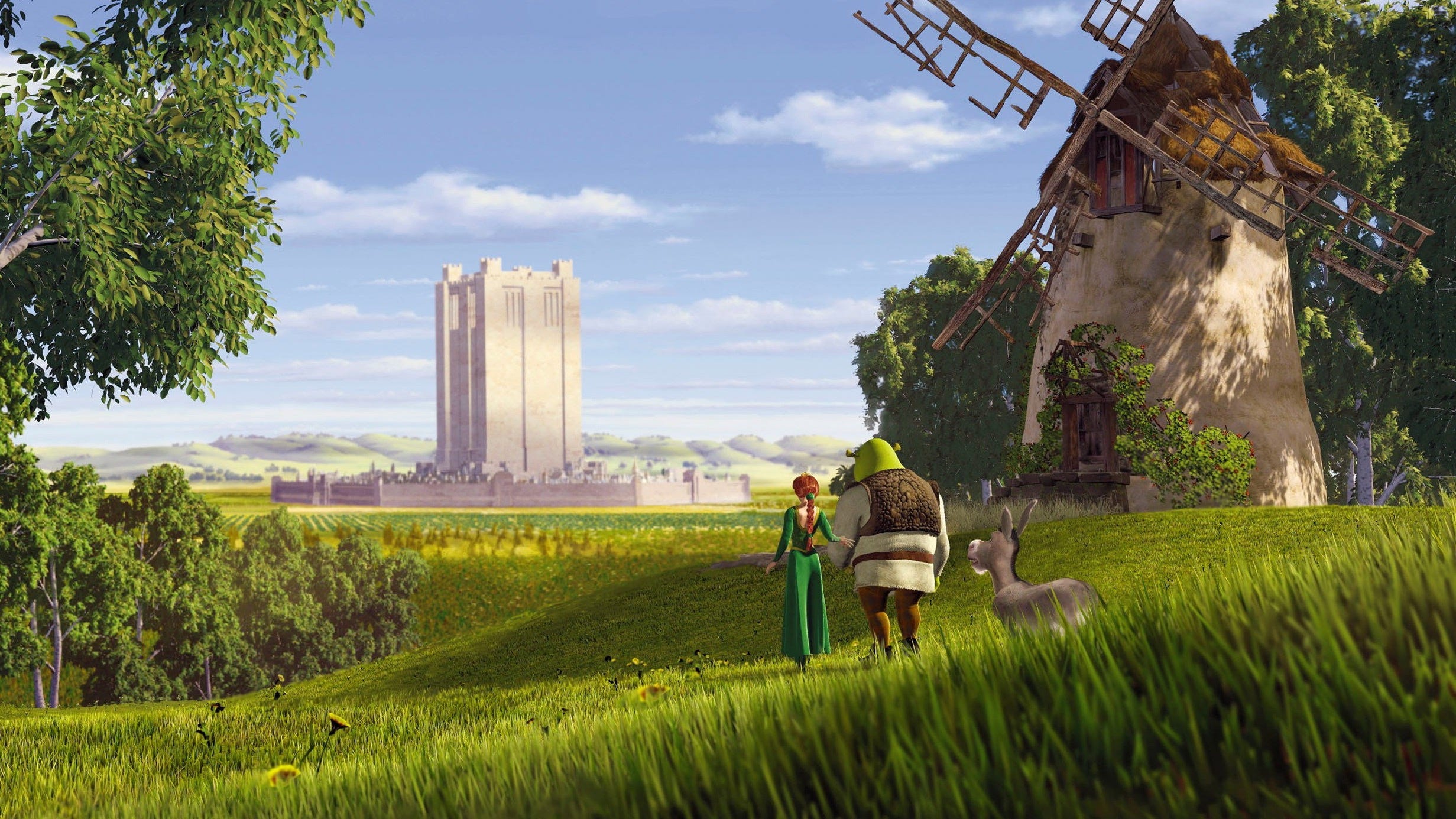
Released in 2001 by DreamWorks Animation, Shrek (2001) tells the story of an ogre of the same name who, after his swamp is overrun by fairy tale characters, must rescue a princess imprisoned in a tower in exchange for the ruler of the city-state driving the creatures out of his land. In Shrek, directors Andrew Adamson and Vicky Jenson make excellent use of fairy tale references, including the Magic Mirror from Snow White and classic characters such as Pinocchio and Peter Pan. These references, however, serve no practical narrative purpose, yet they are essential in shaping the film’s comedic tone and fairy tale setting.
It is also evident that, by cleverly satirizing fairy tales, the film draws clear inspiration from Disney’s versions of these classic stories. There has been considerable debate over the reason behind this choice. It may, in turn, be explained by the fact that Jeffrey Katzenberg, the film’s producer and one of DreamWorks’ founders, was dismissed from Disney under highly contentious circumstances. Nevertheless, that fact makes the jokes even funnier.
Interestingly, despite satirizing fairy tales, Shrek actually follows the classic structure of one. A hero, Shrek (Mike Myers), sets out to rescue a princess imprisoned in a tower, Fiona (Cameron Diaz), accompanied by a talking animal, Donkey (Eddie Murphy). Here, too, we have a vain antagonist, an important moral lesson about beauty, and a happy ending. As a result, Shrek does manage to satirize fairy tales—and does so very well—but it never stops being one, making all of this unusually brilliant and entertaining.
Aside from a few supporting characters, such as Gingy and the charming Dragon, every major event revolves around four characters: Shrek, Fiona, Donkey, and Lord Farquaad (John Lithgow). Over the course of 90 minutes, the film explores complex themes, yet presents each of them in a simple way. Because Shrek has spent his entire life in isolation, he ends up becoming an insecure individual, a trait made evident when, after being asked whether he could be the princess’s true love, he mocks himself. Fiona, meanwhile, pressured to be rescued and live the perfect life with a handsome prince, believes that even Shrek, someone who looks like her, will judge her appearance. As for Donkey, who initially refuses to speak to avoid being sold, he spends the rest of the film talking nonstop. Finally, to compensate for his short stature, Farquaad builds what is essentially the medieval equivalent of the Empire State Building.
While DreamWorks satirized fairy tales in Shrek, Pixar, with Monsters, Inc. (2001), presented the world behind the closet door. By defeating the pioneer of 3D animation, Shrek won the first Academy Award for Best Animated Feature in history. Considering technical quality, Pixar, which developed a specialized software system to simulate the movement of every strand of Sulley’s fur, is certainly superior. However, DreamWorks’ production features genuinely beautiful shots, thanks to its well-crafted color work and dynamic, immersive camera movement. As a result, even if unintentionally, Shrek proves to be an unusual and delightful fairy tale that the Brothers Grimm could never have imagined.